Baking Ingredients

Diversity in Teaching
If you are wondering why gender-sensitive teaching alone is not enough, we recommend our fresh baking yeast. It does not just rise, it also sells like hot cakes.
In addition to gender, there are other diversity characteristics that also play a role in the context of higher education teaching. Alongside ethnicity, social background, disability, age, or religion, gender is therefore just one characteristic that should be considered when thinking about openness and diversity in teaching. Diversity-sensitive teaching therefore takes a wide range of aspects into account in order to include as broad a spectrum of groups of people as possible.
When dealing with diversity in teaching (and in all organisational contexts), it is important to recognize and decide in a context-sensitive way which dimensions of diversity may be relevant and which may not be. Which dimensions play a role in higher education teaching is shown in the figure below. However, diversity characteristics such as gender, origin, socio-economic background, or cognitive abilities are only relevant if they significantly contribute to differences in learning outcomes.
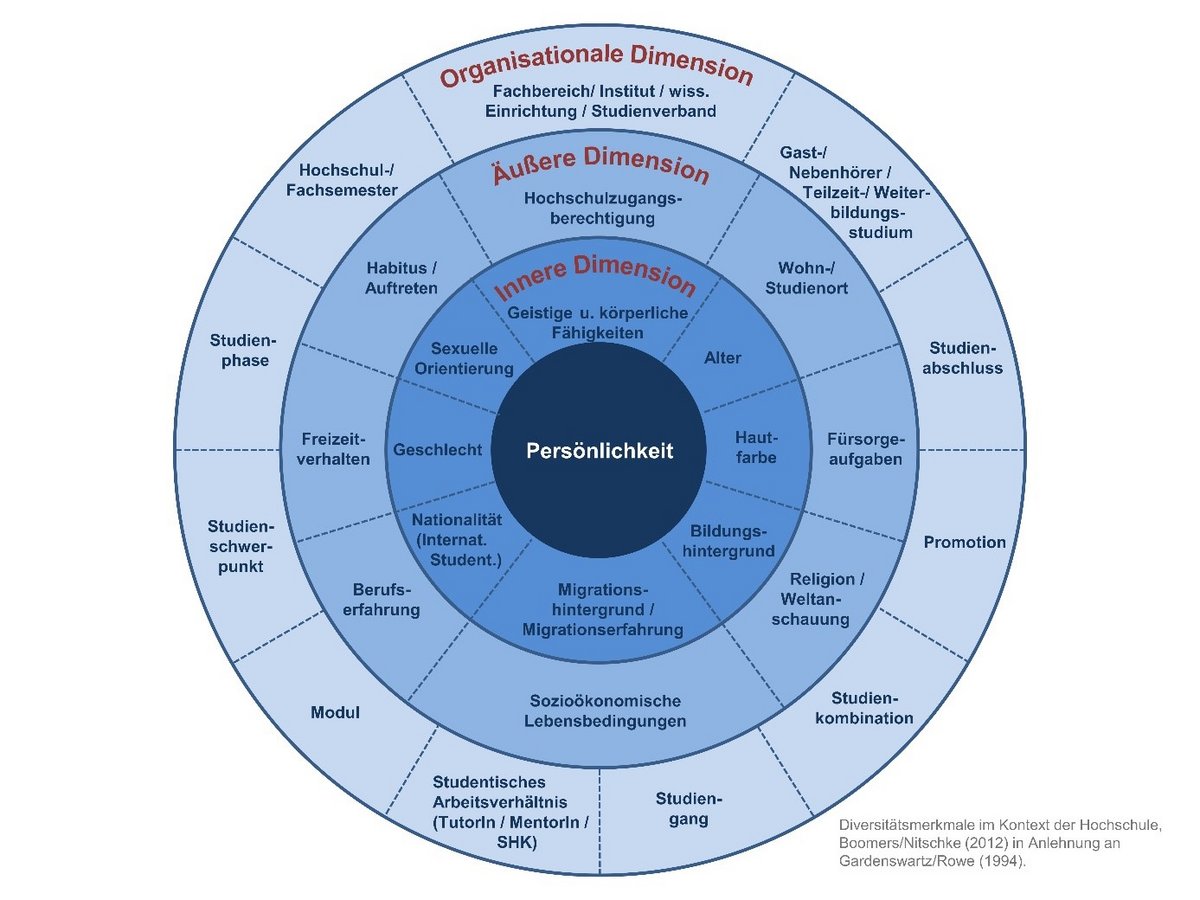
Often, depending on the context, only one dimension plays a decisive role in causing differences and potential unconscious disadvantages. Diversity competence is defined as the “ability of an individual to deal with human heterogeneity in a competent, constructive, and goal-oriented way.” (1)
For teachers and higher education institutions, this involves the task of viewing students as individuals beyond attributions, while at the same time perceiving them in a value-free way within one or more groups of characteristics. In terms of gender- and diversity-conscious teaching, both teachers and students are able to reflect on their own lived realities and experiences and relate them to the academic and subject-specific context. Teachers should be aware of individual needs and apply different didactic methods in order to design courses in a gender- and diversity-sensitive way. A lower dropout rate and reduced staff turnover are just two of the most obvious benefits of a diverse learning culture.
Another important aspect is the systematic review of teaching content for stereotypes and discrimination. This helps prevent unconscious discriminatory structures—often formed early in life through socialization, media consumption, and cultural influences—from being passed on to students without reflection. Historically developed power structures can also influence the unequal treatment of certain groups. Structural discrimination shaped by patriarchal and postcolonial histories disadvantages marginalized individuals and can occur in the form of intersectional discrimination, also within higher education contexts.
The first step toward more diverse and inclusive teaching is becoming aware of structural discrimination as well as one’s own internalized thought patterns and behaviors. But how can these patterns be identified?
Here are some initial guiding questions for self-reflection:
Which dimensions of diversity do I know?
Which ones am I aware of?
How do I perceive them, including unconsciously?
Who are our “average students”?
How do I perceive them?
Can I recall specific examples or experiences?
Further tips and questions for self-reflection will be published here soon.
Diverse and inclusive teaching provides added value for all students and for teachers themselves. It not only promotes equal opportunities but also enriches the learning process through the inclusion of different perspectives and experiences. Through a more successful and satisfying learning atmosphere overall, teachers themselves receive greater affirmation and recognition from students. We are also role models in interpersonal interaction.
Sources:
(1) Aichinger, Regina; Frank Linde and Nicole Auferkorte-Michaelis 2020: Diversity at universities – opportunities and challenges on the way to excellent and inclusive universities. ZFHE Journal for Higher Education Development. Vol. 15, No. 3.
Kahnemann, Daniel 2011: Thinking, Fast and Slow, Siedler Verlag Munich.
The term “intersectionality,” developed by Kimberlé Crenshaw, describes the interplay of different dimensions of diversity:
None of these dimensions can be considered in isolation. Rather, it is the overlaps, interactions, and interconnections (“intersections”) of these dimensions that must be analyzed. Intersectionality is a scholarly and feminist concept used to describe how different forms of discrimination interact, overlap, and depend on one another. In this way, multiple inequalities and systems of oppression can be taken into account that cannot be explained by the category of gender alone.
A person is not only a woman, Black, or homosexual. All diversity dimensions must be considered together, because this person experiences discrimination differently than a white, homosexual woman – whose experiences in turn differ from those of a white, heterosexual woman. The concept of intersectionality can therefore help to understand and contextualize complex experiences of discrimination.
In everyday university life, a basic awareness of different dimensions of diversity can be helpful, for example in recognizing discriminatory behavior and responding appropriately. At the same time, students are being prepared for the labour market and their future professional lives through higher education. Therefore, they should already be taught during their studies that all students, regardless of their diversity characteristics, are entitled to the same opportunities—both at university and later in their careers.
Sources:
“Intersectionality explained briefly” – Vielfalt Mediathek
Designing teaching in a diversity-sensitive and inclusive way requires a solid understanding of diversity dimensions and forms of discrimination. Therefore, awareness-raising and further training of teaching staff are considered central components of a diversity-sensitive and inclusive teaching and learning culture.
The following steps can support teachers in this process:
Self-reflection on one’s own position:
This includes reflecting on one’s own socialisation, educational biography, and current life situation, including privileges and marginalisations, as well as one’s role within systems and existing power relations. As stated: “The inner attitude, often shaped by unconscious thought patterns and stereotypes, influences how one acts towards different groups of students.” (2)
Awareness of diversity and heterogeneity among students:
Students may be young or older, parents or caregivers. They may be healthy, chronically ill, or living with disabilities. These different life realities directly affect their time availability, mental capacity, attendance at university, and academic performance. Awareness of this diversity creates the basis for acceptance and tolerance.
Reducing uncertainty through knowledge acquisition:
In addition to other barriers, uncertainty and feelings of being overwhelmed among teachers often pose a challenge to diversity-sensitive teaching. It is therefore recommended to use higher education didactic training programmes and engage in continuous professional development in order to reduce uncertainty and overcome reservations about diversity-related topics.
Trying new approaches and practicing didactic creativity:
Designing diversity-sensitive teaching is a co-constructive process that begins with self-reflection and awareness-building and continues in an inclusive teaching and learning environment. A wide range of didactic methods can be used to address as many students as possible – the Gil&Toni toolbox provides support for this.
Using one’s own resources:
Action spaces arising from personal privileges and existing power structures can be used deliberately to promote diversity sensitivity in higher education. This includes, for example, adapting curricula to provide students with access to diversity competence. The experience of self-efficacy gained through inclusive teaching practices can motivate both teachers and students and increase enjoyment of teaching.
Source:
(2) diversity-in-der-lehre-Leitfaden2021.pdf
https://www.pedocs.de/volltexte/2015/11398/pdf/Klages_2015_Gestaltungsraum_Hochschullehre.pdf
Inclusive teaching
Article 26 (1) of the Universal Declaration of Human Rights states:
“Everyone has the right to education. Education shall be free, at least in the elementary and fundamental stages. Elementary education shall be compulsory. Technical and professional education shall be made generally available and higher education shall be equally accessible to all on the basis of merit.” (3)
In relation to teaching, even small changes in teaching practice can enable participation for all students and support them in fully developing their potential.
Recommendations for inclusive teaching include the following aspects:
Taking different learning speeds into account:
Everyone learns at their own pace. Some students learn quickly, while others need more time. Flexibility and a variety of learning resources can support inclusion, for example through video or audio recordings that can be played at individually chosen speeds.
Respectful and non-discriminatory communication:
Stereotyping and other forms of discrimination should be avoided in teaching. Gender-sensitive language, ALT text for images, and transparent communication of expectations (e.g., for exams) can contribute to more inclusive teaching and improve student well-being.
Designing accessible learning materials:
Accessibility refers not only to physical infrastructure but also to making content understandable, readable, and accessible for all students. This includes ALT texts, high-contrast design, avoiding problematic visual contrasts (e.g., white text on black background where inappropriate), subtitles for videos, and transcripts for audio content. Materials should also be regularly reviewed and expanded to include perspectives of marginalised groups.
Acceptance of different life situations:
Many students cannot study full-time or devote additional time outside of university due to work, caregiving responsibilities, or volunteering. These circumstances are often unknown, and students should not have to justify them. Providing information about support services can help, but often empathy and understanding are already significant factors.
Fair assessment conditions:
Exams, oral assessments, and written assignments can be challenging, especially for students with anxiety or learning difficulties. Where possible, students should be involved in choosing assessment formats. Clear and transparent communication of requirements and procedures can reduce anxiety and uncertainty.
Knowing contact persons and support services:
Universities can be complex systems. Therefore, it is important to know key contact points, guides, maps, and relevant structures in order to support students effectively and reduce barriers in everyday academic life.
Sources:
diversity-in-der-lehre-Leitfaden2021.pdf
(3) https://unric.org/de/allgemeine-erklaerung-menschenrechte/
https://www.pedocs.de/volltexte/2015/11398/pdf/Klages_2015_Gestaltungsraum_Hochschullehre.pdf